
Custom Video Technology: Why Professional Streaming Hardware Should Be Tailored to Your Needs
An encoder can stream video. But can it do exactly what your project needs? If you’re producing a livestream for
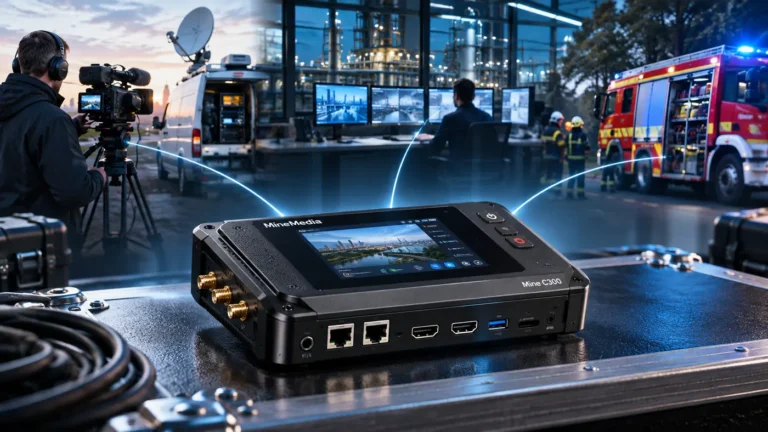
A livestream of a corporate event is one thing. A reliable video transmission from a moving emergency vehicle, an industrial facility, or a mobile TV studio is something entirely different. After all, not every location has stable Wi-Fi, a power outlet, and a technician who can quickly restart the encoder if problems arise. Some applications demand more. Custom transmission paths, specialized cellular configurations, remote control capabilities, or direct integration into existing systems.
That’s exactly what OEM streaming hardware is for: professional video technology that adapts to the application—not the other way around.
Traditional video encoders are ideal for many applications. Connect the camera, configure the streaming destination, and start streaming. But what happens when a company has completely different requirements?
For example, a television station may want to transmit multiple independent video signals over different networks. An industrial facility may need a permanently installed camera transmission system that can be monitored centrally. A mobile field unit may need to be able to switch between different cellular connections. The challenges vary, but the question remains the same:
How can a video transmission system be designed to function under actual operating conditions?
The answer often lies not in yet another off-the-shelf device, but in a customized hardware and software solution.
Network connectivity is a critical factor, especially for mobile video transmissions. While traditional events often rely on an existing Internet connection, specialized applications may require significantly more flexible solutions. These include, for example, dedicated SIM cards, custom mobile service contracts, different modems, or multiple independent network connections. With the right OEM configurations, such requirements can be taken into account as early as the device development stage.
Let’s imagine a mobile production team that needs to transmit live footage from various locations to a broadcast center. At one location, mobile carrier A works perfectly, but a few kilometers away, carrier B offers better coverage. In this scenario, multiple mobile connections can be useful. Depending on the technical implementation, they can be operated redundantly or combined using carrier aggregation. Separate signal paths may also be necessary, for example, when different video sources need to be transmitted independently. It is crucial that the hardware used is compatible with the desired network architecture.
In addition to the connection, image quality naturally plays a role as well. In professional video technology, high-resolution signals have long been the norm. High levels of detail can be particularly important in the broadcast sector, during technical inspections, or for specialized surveillance tasks.
Custom OEM solutions can therefore be designed for specific video formats and resolutions—depending on the device platform, even for requirements up to 4K at 60 frames per second.
This depends on the interaction of all components: video input, encoder, network connection, and reception system. After all, a 4K60 source alone does not guarantee end-to-end 4K60 transmission. Therefore, the resolutions, frame rates, and concurrent functions that are actually possible are technically evaluated for each project.
There are applications where the demands on video communication are particularly high. In industrial facilities, cameras can be used to monitor technical processes. Energy providers may need video footage from remote locations. Television stations must reliably transmit signals from on-location productions. Fire departments, police, and other emergency response organizations can also use mobile video technology, for example, to transmit situational overviews or to document operations. Even in military or government settings, specialized video transmission systems are a key consideration.
However, such applications often have specific requirements regarding network architecture, access control, availability, and data processing. An OEM solution makes it possible to take these requirements into account right from the technical design phase.
It is important to note that not all professional streaming hardware is automatically suitable for security-critical environments. The necessary security measures must be developed, tested, and, if necessary, certified on a case-by-case basis.
Another advantage of customizable streaming hardware lies in software integration. Instead of operating each device through a separate user interface, such systems can be integrated into your own applications via an API. This opens up interesting possibilities.
For example, a television station could manage multiple encoders using central software. An industrial company could integrate the video technology with an existing surveillance system. A system integrator could develop its own user interface tailored precisely to its customers’ workflows. Automated processes are also possible: A device could start a transmission as soon as certain conditions are met, or report its current operating status to a central application.
The features available depend on the specific API and firmware capabilities. The big advantage is that companies don’t necessarily have to develop all the hardware themselves to implement a customized solution.
At Livestream Shop, we partner with manufacturers of professional video and streaming equipment. These include MineMedia, a manufacturer of mobile encoders and video transmission systems. As part of this partnership, we also offer customization options.
If project requirements call for it, we can work with the manufacturer to determine whether, for example, specific firmware functions, customized device management, or additional recording and streaming features can be implemented. This is particularly beneficial for larger projects and production applications. Instead of developing an entirely new hardware platform from scratch, we can build upon existing technology. This can reduce development effort while also providing greater flexibility when integrating into existing systems.
How is an OEM solution like this developed? It doesn’t start with the device, but with the requirement.
Which video signals need to be transmitted? What resolution is required? Will the connection be made via cellular, Ethernet, or multiple networks? Should the hardware be controlled using dedicated software? Are there any specific requirements regarding security or availability?
These questions form the technical basis. We can then work with the manufacturer to determine which existing platform is suitable and what modifications are necessary. The result may be a custom-configured version of an existing device—or a more extensive OEM development project.
The more specialized an application is, the more important it becomes to be able to customize streaming hardware. Whether it’s mobile TV production, industrial video transmission, or sophisticated communications infrastructure, standard features aren’t always enough. With OEM hardware, custom-configured network connections, and API interfaces, it’s possible to develop solutions that go far beyond the traditional live stream encoder.
And that’s exactly where we want to start with the Livestream Shop.
We help companies, developers, and system integrators find the right hardware and work with our manufacturers to evaluate customized technical solutions.
Do you need specialized video transmission technology, custom interfaces, or a tailored OEM solution?
Then get in touch with us. We look forward to working on projects that don’t fit the standard mold: 089 41 41453 50 or by email at hello@livestream-shop.com.
An encoder can stream video. But can it do exactly what your project needs? If you’re producing a livestream for
When people in Germany talk about live shopping, they often still hear, “That only works in China.” A look across
More than 2,000 kilometers. About 30,000 meters of elevation gain. Several days with almost no breaks. And while Sebastian “Basti”
You are currently viewing a placeholder content from Vimeo. To access the actual content, click the button below. Please note that doing so will share data with third-party providers.
More InformationYou are currently viewing a placeholder content from YouTube. To access the actual content, click the button below. Please note that doing so will share data with third-party providers.
More InformationYou need to load content from reCAPTCHA to submit the form. Please note that doing so will share data with third-party providers.
More InformationYou are currently viewing a placeholder content from Vimeo. To access the actual content, click the button below. Please note that doing so will share data with third-party providers.
More InformationYou are currently viewing a placeholder content from YouTube. To access the actual content, click the button below. Please note that doing so will share data with third-party providers.
More InformationYou are currently viewing a placeholder content from Bunny Stream. To access the actual content, click the button below. Please note that doing so will share data with third-party providers.
More InformationYou are currently viewing a placeholder content from Wistia. To access the actual content, click the button below. Please note that doing so will share data with third-party providers.
More InformationYou are currently viewing a placeholder content from Facebook. To access the actual content, click the button below. Please note that doing so will share data with third-party providers.
More InformationYou need to load content from reCAPTCHA to submit the form. Please note that doing so will share data with third-party providers.
More InformationYou are currently viewing a placeholder content from Instagram. To access the actual content, click the button below. Please note that doing so will share data with third-party providers.
More InformationYou are currently viewing a placeholder content from X. To access the actual content, click the button below. Please note that doing so will share data with third-party providers.
More Information