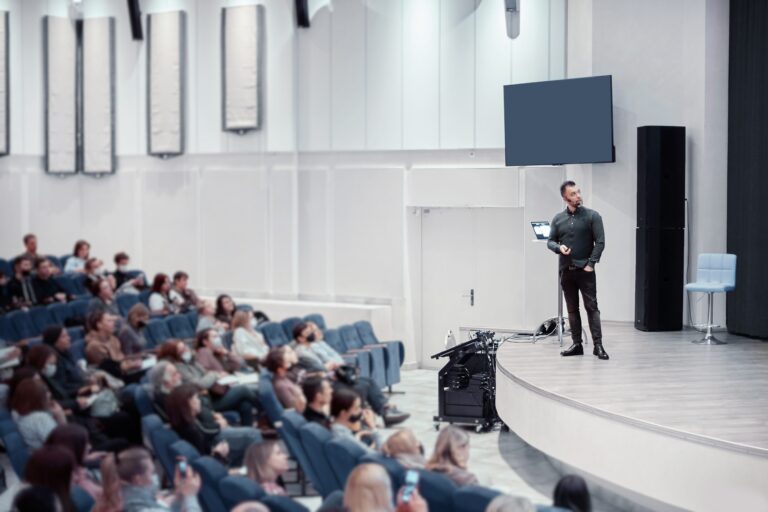
The red “on-air” light is on, your event is underway, and now the technology has to deliver. Yet many companies make the same mistake: they opt for the highest resolution and overlook the critical factors. A choppy stream or a blurry image can ruin even the best presentation, because audiences are no longer willing to tolerate technical glitches.
That’s why automatically defaulting to the highest resolution is often the wrong approach and puts an unnecessary strain on your venue’s network. When it comes to streaming, more isn’t necessarily better. What matters most is the perfect combination of the right resolution, absolutely reliable hardware, and available bandwidth.
This guide takes you straight to the practical side of things and shows you when Full HD is more than enough for your needs, how 4K can make your brand shine, and how you can ensure every broadcast runs smoothly and stress-free. Avoid costly mistakes and instead send a signal that captivates your audience from the very first moment.
Getting Started: Professional Livestreaming in Full HD
Full HD (1920 × 1080 pixels) remains the optimal choice for many business applications. Internal meetings, webinars, training sessions, or small product presentations with a predominantly mobile audience benefit little from higher resolutions. On smartphones and tablets, 4K is barely noticeably sharper than Full HD; the difference simply gets lost on small screens. At the same time, the bandwidth and processing power requirements for Full HD streams are significantly lower, which improves transmission stability and predictability.
An often-overlooked point: When it comes to streaming, it’s not the resolution that determines perceived quality, but rather the sound and lighting. A well-lit scene with clear audio in 1080p looks more professional than a 4K image with a poor microphone and harsh shadows. If you want to improve video quality in this area, you’re better off investing in lighting and sound first rather than in more megapixels.
For camera equipment, we recommend a reliable PTZ camera such as the Canon CR-N500 or the Sony FR7. For a central transmission solution, we recommend the MiNE Q8 4G Livestream Bonding Encoder—a compact hardware encoder (a device that compresses the camera’s raw video signal and transmits it directly over the internet to platforms or your own servers) for mobile, stable Full HD streaming. Particularly convenient: The MiNE Q8 can also be operated via cellular networks, making it suitable for events at locations without a secure LAN connection. Anyone looking for livestream equipment that works immediately without a major setup effort will find a mature solution here for daily use.
The Place to Be: High-End Livestreams in 4K & HDR
Once a certain level of quality is needed, Full HD is no longer sufficient, because certain formats rely on crystal-clear images as part of their message. Whether it’s product launches for international brands, high-end brand events, or content that’s repurposed as on-demand material after the live event, 4K streaming (3840 × 2160 pixels—four times as many pixels as Full HD) pays off immediately.
What matters here is not just the resolution, but also the dynamic range. HDR (High Dynamic Range) ensures that bright highlights don’t get blown out and dark shadows don’t get lost in the darkness. The result: images that appear three-dimensional, vivid, and true to human perception.
The biggest technical hurdle for 4K livestreaming: transmission bandwidth. A properly encoded 4K HDR stream requires a stable upload speed of between 15 and 40 Mbit/s, depending on the codec (H.265/HEVC or AV1)—a requirement that often cannot be reliably met with a single internet connection at trade shows, event venues, or in outdoor settings.
This is where bonding comes into play: multiple internet connections are bundled into a single, stable connection. If one connection fails or becomes unstable, the others seamlessly take over. The result is a fail-safe, high-bandwidth uplink solution that is essential for critical live events.
For 4K events, we recommend the MiNE M4 Mini: a compact bonding encoder and router that aggregates multiple SIM cards and Ethernet connections while delivering high-performance encoding even under challenging network conditions. The added value lies in the combination: high-quality 4K video compression, robust bonding, and a compact design that fits into any flight case setup.
The Top Tier: When 8K Really Makes Sense—and When It Doesn’t
Let’s be honest: For businesses, 8K livestreaming in 2026 is still a bit overkill. In most cases, the infrastructure is lacking on multiple fronts. Hardly any devices support native 8K playback. While platforms like YouTube do support 8K uploads, the audience rarely has the necessary display hardware and internet connection to notice the difference from 4K. And the bandwidth requirements of an 8K stream—realistically 80 to 100 Mbit/s of stable upload—far exceed the capabilities of most transmission infrastructures.
Today, 8K is the domain of broadcast professionals, film productions, and major events with dedicated on-site fiber-optic infrastructure. Anyone working in this field already knows that.
For most companies, building a future-proof IP production infrastructure based on NDI (Network Device Interface: a standard that enables lossless video transmission over IP networks) makes more sense than jumping straight to 8K hardware. NDI makes cameras, encoders, switchers, and monitors network-ready; data, video, and audio are transmitted and the devices are powered using only patch cables. And: the entire system is fully scalable. Those who invest in NDI-capable hardware today are prepared for higher resolutions and more complex productions without having to rebuild the entire infrastructure.
If you’re unsure whether 8K, NDI, or another solution is the right next step for your production strategy, the team at livestream-shop.com would be happy to advise you personally!
The right technology for your event
Three tiers, three clear recommendations: Full HD for stable, mobile, and low-bandwidth applications with a focus on sound and lighting. 4K & HDR as the professional standard for events where image quality is part of the brand message. 8K and NDI as a glimpse into the future for anyone who wants to build tomorrow’s infrastructure today.
Entscheidend ist nicht die höchste verfügbare Auflösung, sondern die richtige Auflösung für Ihren konkreten Einsatz. Wer das versteht, spart Budget, vermeidet technische Risiken und liefert seinem Publikum genau das, was es erwartet: einen Stream, der einfach funktioniert.
Discover our full range of professional livestreaming equipment at livestream-shop.com, or contact us directly. Call us at 089 41 41 453 50 or email us at hello@livestream-shop.com
We’ll help you find the right equipment for your event.